
The Daily Brew and the Overworked Brain
If you’re like many Wellington locals juggling work, training, and life’s general chaos, that second coffee can feel like a well-deserved treat. A daily ritual. A personality trait, even.
But your nervous system may quietly be whispering, “Mate… calm down.”
While caffeine can sharpen focus and help you power through busy days, crossing the line from “helpful stimulant” to “constant neurological stressor” happens much faster than most people realise. And because the nervous system controls every movement, thought, recovery phase, and emotional response, it feels the impact long before you do.
That second coffee doesn’t just wake you up. It winds you up.
How Caffeine Actually Works on the Nervous System
Caffeine blocks adenosine, the calming neurotransmitter that signals the brain to relax. With adenosine’s brakes removed, the brain shifts into alert mode, increasing neural firing and stress hormones. Great when you need a boost. Not so great when it becomes a daily baseline.
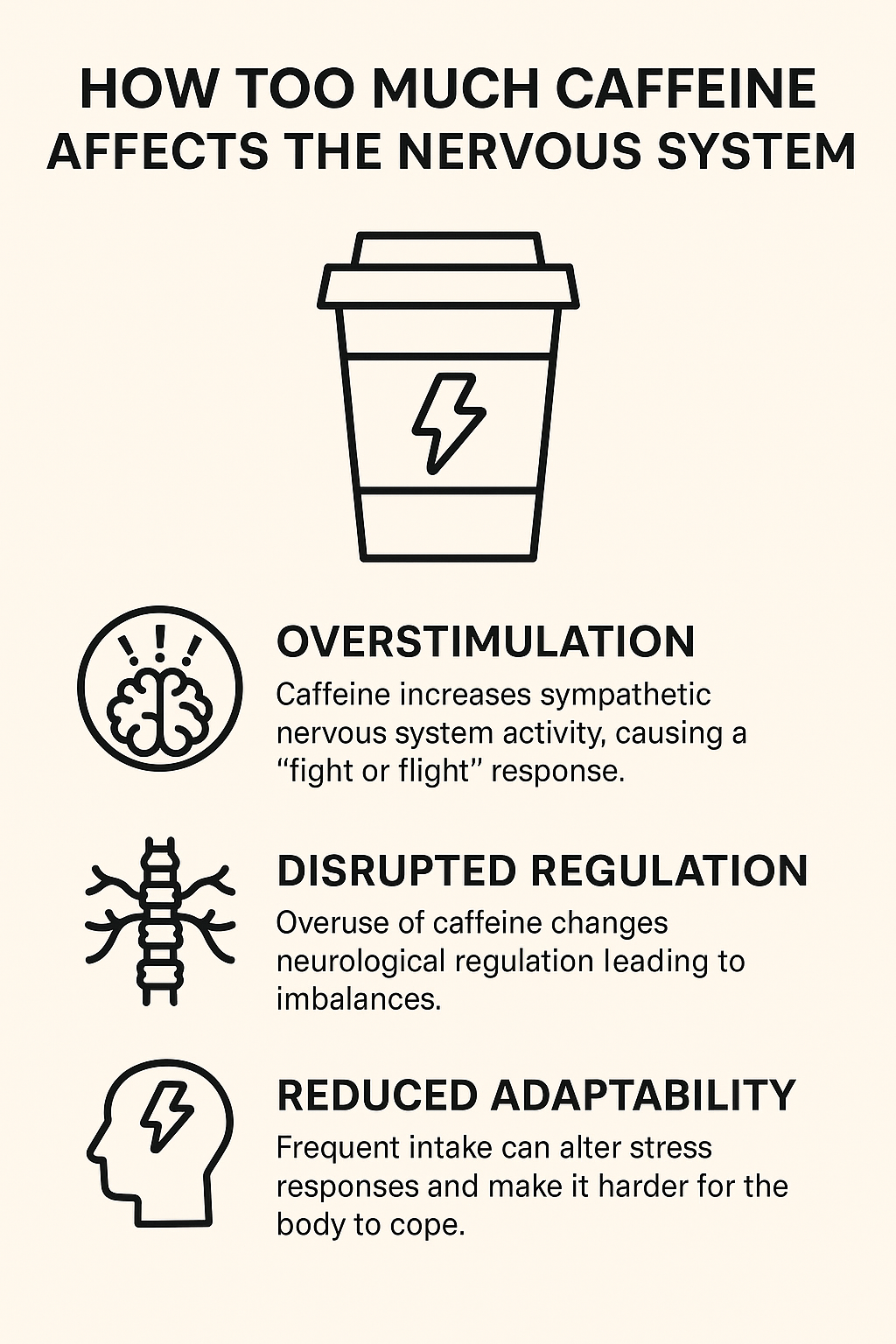
Research from the Journal of Psychopharmacology shows that caffeine significantly increases sympathetic nervous system activity—the “fight or flight” division of your autonomic system (Lovallo et al., 2006). When this system dominates too often, digestion slows, sleep worsens, recovery drops, muscles stay tense, and overall adaptability declines.
In other words, that extra long black doesn’t just perk you up; it tweaks the body’s entire stress physiology.
When Daily Stimulation Becomes Daily Stress
The human nervous system is built to move between activation and recovery. Caffeine pushes heavily toward activation.
Over time, people begin to feel:
“wired but tired,”
“unable to switch off,”
“sleeping but not actually recovering,”
“tight shoulders and neck,”
“a buzzy brain that just won’t settle.”
Ironically, many then reach for another coffee to counteract the fatigue caused by too much caffeine.
Excessive sympathetic activation reduces coordination, elevates cortisol levels, and disrupts your brain’s natural rhythms. Studies show that high caffeine intake interferes with deep restorative sleep, the very phase required for neurological reset and muscle repair (Drake et al., 2013).
It’s the physiological equivalent of running your phone with 12 apps open: performance looks fine at first… until it suddenly doesn’t.
Caffeine, Movement, and Subluxation Patterns
Here’s where chiropractic neurology ties into the story.
When the nervous system is overstimulated, muscles tighten to protect you, movement patterns compensate, and joints lose their normal motion. This creates the perfect environment for subluxation patterns and joint dysfunction in the spine.
At our Wellington chiropractic clinic, it’s common to see clients experiencing tension-based issues—tight upper backs, restricted thoracic rotation, jaw tension, headaches—that stem not only from posture or exercise but from chronic neurological overstimulation.
Caffeine doesn’t directly cause these issues. It simply shifts your nervous system into a state where small physical stresses create large neuro-muscular consequences.
Sleep: The Recovery System You Can’t Outsmart
A single afternoon latte can reduce restorative sleep by up to 20%, even when you fall asleep without difficulty. Your nervous system may feel tired, but biologically it is still in “alert mode.”
The kicker? Caffeine lingers far longer than most people think.
Its average half-life is 5–6 hours, meaning that if you enjoy a 2:00 pm flat white, half the caffeine is still circulating at 7:00–8:00 pm. For some people—due to genetics, pregnancy, liver metabolism, or certain medications—that half-life can stretch closer to 9 hours or more. It can take up to 24 hours for caffeine to fully clear your system.
So even when you think you’re winding down for bed, your brain is still dealing with residual stimulation, increased sympathetic tone, and suppressed adenosine signalling. Research confirms that evening caffeine disrupts slow-wave and REM sleep cycles (Drake et al., 2013), leaving the nervous system under-recovered by morning.
Deep sleep activates the brain’s glymphatic system—a wash cycle that clears metabolic waste. Poor sleep slows this process significantly. Research published in Science shows that inadequate deep sleep increases neuroinflammation and impairs cognitive performance (Xie et al., 2013).
Combine chronic caffeine intake with sympathetic dominance and insufficient deep sleep, and you build a tense, reactive, easily-fatigued system—exactly the opposite of what we want neurologically.
You can’t outsmart your biology.
But you can support it.
How Chiropractic Helps a Stressed Nervous System Adapt Better
Chiropractic adjustments restore proper spinal movement, reduce mechanical tension on the nervous system, and improve communication between the brain and body. When subluxations and joint dysfunction are cleared, your nervous system can regulate more effectively, adapt to stress, move efficiently, and recover faster.
Once their neurological load reduces, many clients notice improved sleep, fewer cravings for caffeine, a calmer mental state, and less tension throughout the body.
A well-adjusted nervous system doesn’t need as much artificial stimulation—because it’s operating efficiently on its own.
A Healthier Relationship with Your Daily Brew
You don’t need to break up with caffeine. But you may need to stop seeing it multiple times a day.
Supporting your nervous system through precise neurological chiropractic care helps your body handle stress better, move better, sleep better, and ultimately depend less on stimulants to feel normal.
If you’ve been struggling with tightness, headaches, anxiety, poor sleep, or that notorious “wired but tired” state, your nervous system may be asking for a reset.
Before you blame your life choices… maybe just start by rethinking that second cup.
References
Lovallo, W. R., et al. (2006). Caffeine may potentiate stress responses in humans. Journal of Psychopharmacology, 20(6), 895–903.
Drake, C., et al. (2013). Caffeine effects on sleep taken 0, 3, or 6 hours before bedtime. Journal of Clinical Sleep Medicine, 9(11), 1195–1200.
Xie, L., et al. (2013). Sleep drives metabolite clearance from the adult brain. Science, 342(6156), 373–377.
Experience Limitless Movement Chiropractic Care in Wellington
If you’re in Wellington and looking for expert chiropractic care, we’re here to help. At Limitless Chiropractic, we focus on helping you move better, feel stronger, and live without limits. Book your appointment today and take the first step toward a healthier, more mobile you!
Ready to begin or continue your healing journey? Let’s work together to unlock your body’s natural potential for wellness.
Book Your Limitless Journey Today
or call us at (04) 891 0911