
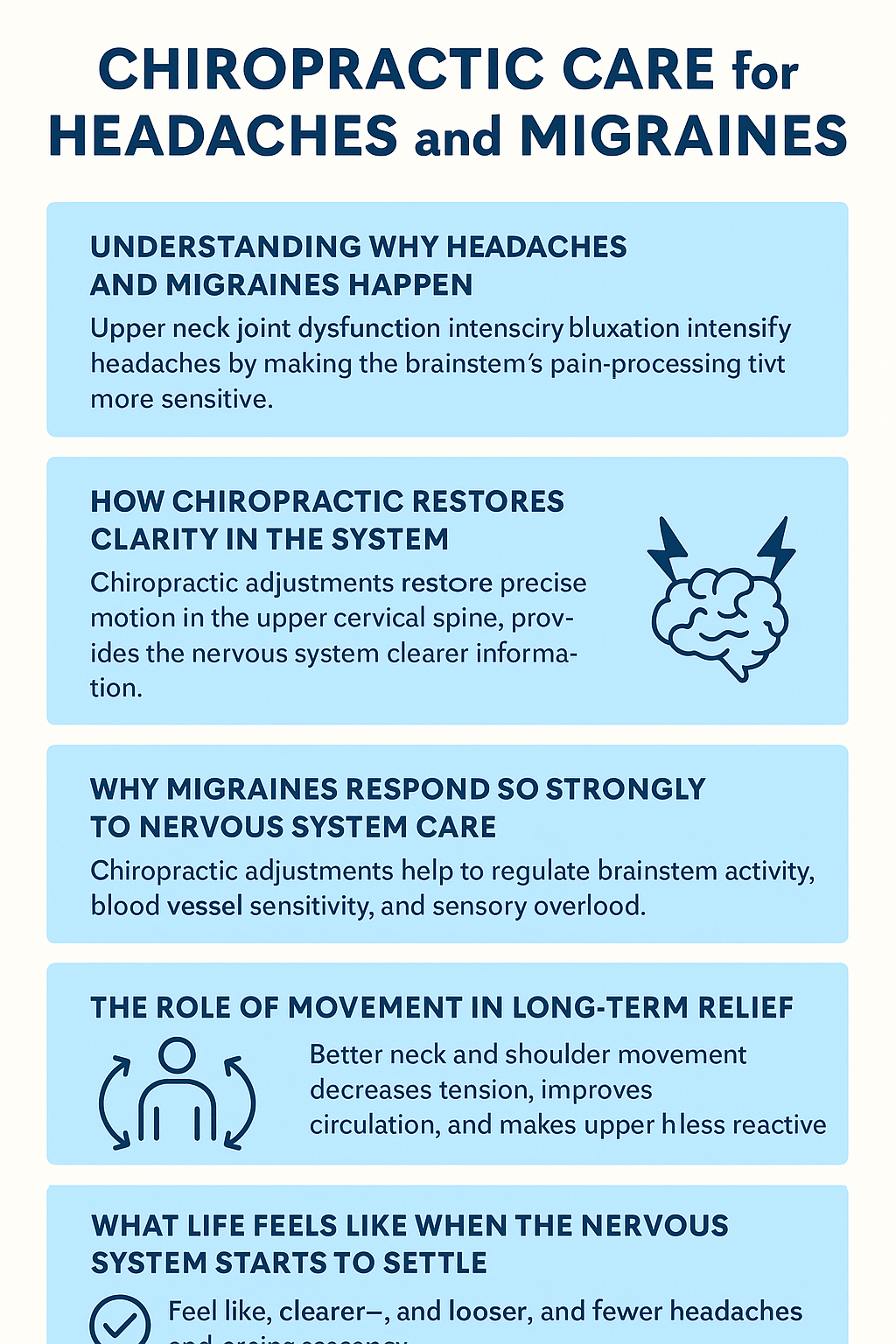
Understanding Why Headaches and Migraines Happen
Headaches and migraines rarely appear out of nowhere. They tend to build quietly as the nervous system becomes overloaded by work stress, screen time, poor sleep or long periods of sitting. Over time, the upper neck and shoulder stabilisers tighten, movement becomes restricted and the brain receives distorted information from the joints that should help it orient the head and regulate muscle tone.
When the upper neck loses proper motion — often due to joint dysfunction and the presence of a subluxation — the brainstem’s pain-processing centres become more sensitive. Research shows that limited cervical movement and altered proprioceptive signalling can amplify headache frequency and intensity (Bogduk, 2014; Schmid et al., 2020). This overload often snowballs into shoulder tension, eye strain, difficulty focusing and a nervous system that struggles to adapt to even mild stress.
How Chiropractic Restores Clarity in the System
Chiropractic care works by improving the way the brain and body communicate. A chiropractic adjustment restores precise motion at specific spinal segments, particularly in the upper cervical spine where headaches often originate. When movement becomes clearer, the nervous system receives more accurate sensory information, and in response, muscle tone decreases, posture improves naturally and the body shifts out of protective mode.
Studies show that chiropractic adjustments can create measurable changes in how the brain processes sensory information, coordinates movement and activates muscles (Haavik & Murphy, 2012; Taylor et al., 2021). People often describe this as feeling “lighter,” “clearer” or “more in control” after their adjustments — not because pain magically disappears, but because the nervous system finally gets the green light to recalibrate and relax.
Why Migraines Respond So Strongly to Nervous System Care
Migraines involve a highly sensitive neurological landscape. The brainstem becomes reactive, sensory inputs become overwhelming and blood vessels begin responding erratically. When the spine isn’t moving well, especially in the upper neck, this sensitive system becomes even more vulnerable. Chiropractic adjustments help regulate this circuitry by calming the overload and allowing the brain to process incoming information more accurately.
Research has shown meaningful reductions in migraine days, pain levels and medication use following chiropractic care (Tuchin et al., 2000; Chaibi & Russell, 2017). This improvement is often linked to better regulation within the brainstem and improved adaptability throughout the nervous system. In other words, when the spine moves better, the brain reacts less.
The Role of Movement in Long-Term Relief
Once the nervous system begins receiving clearer information from the spine, movement quality improves throughout the entire neck and shoulder complex. The deep stabilising muscles start to activate again, the overworked upper-trap region begins to settle and the shoulders regain proper mechanics. Even everyday actions like turning your head while driving or lifting your arms feel more fluid and less forced.
As movement normalises, blood flow improves, joint pressure decreases and the entire upper neck becomes less reactive. People often notice that headaches take longer to build, recover more quickly and eventually become far less frequent. This shift isn’t just structural; it’s neurological — better movement equals better adaptability.
Local Factors and Why Wellington Lifestyles Matter
Many people in Wellington juggle high-pressure work, long commutes, wind-induced postural changes (classic Wellington), active lifestyles and screen-heavy jobs. These influences, when combined, can quietly feed into the tension patterns that create chronic headaches and migraines.
At our Wellington chiropractic clinic, we take a neurological and movement-based approach to understand not just where your pain is coming from, but why your system is struggling to adapt. Structural findings like forward head posture, rounded shoulders or upper-neck stiffness still matter, but their true impact lies in how they affect the nervous system’s ability to regulate itself.
What Life Feels Like When the Nervous System Starts to Settle
As the system becomes more efficient, people describe their minds feeling clearer, their shoulders staying looser throughout the day and their sleep improving without effort. Headaches become less intense, migraines lose their grip, and recovering from everyday stress becomes noticeably easier. The nervous system moves from protection back to adaptation — exactly where it’s designed to be.
If You’re Ready to Move With Less Pressure
If headaches or migraines have been interrupting your routine, limiting your training or draining your energy, your body may be signalling that deeper neurological tension needs to be addressed. A thorough chiropractic assessment can help identify whether a subluxation, a movement imbalance or a nervous system overload is contributing to your symptoms and what steps will help restore ease.
Relief is absolutely possible — and often begins with restoring proper motion and allowing the nervous system to breathe again.
Scientific References
- Bogduk, N. (2014). The anatomy and pathophysiology of neck pain. Phys Med Rehabil Clin N Am, 25(2), 367–374.
Chaibi, A., & Russell, M. B. (2017). Manual therapies for migraine: A systematic review. The Journal of Headache and Pain, 18(1), 1–17. - Haavik, H., & Murphy, B. (2012). The role of spinal manipulation in influencing the neuromuscular system. Chiropractic & Manual Therapies, 20(1), 20.
- Schmid, A. B., et al. (2020). Involvement of cervical proprioception in headaches. Musculoskeletal Science and Practice, 45, 102095.
- Tuchin, P. J., et al. (2000). A randomized controlled trial of chiropractic spinal manipulative therapy for migraine. Journal of Manipulative and Physiological Therapeutics, 23(2), 91–95.
- Taylor, H. H., Holt, K., & Murphy, B. (2021). Brain function changes after chiropractic care. Neural Plasticity, 2021, 1–12.
Experience Limitless Movement Chiropractic Care in Wellington
If you’re in Wellington and looking for expert chiropractic care, we’re here to help. At Limitless Chiropractic, we focus on helping you move better, feel stronger, and live without limits. Book your appointment today and take the first step toward a healthier, more mobile you!
Ready to begin or continue your healing journey? Let’s work together to unlock your body’s natural potential for wellness.
Book Your Limitless Journey Today
or call us at (04) 891 0911