
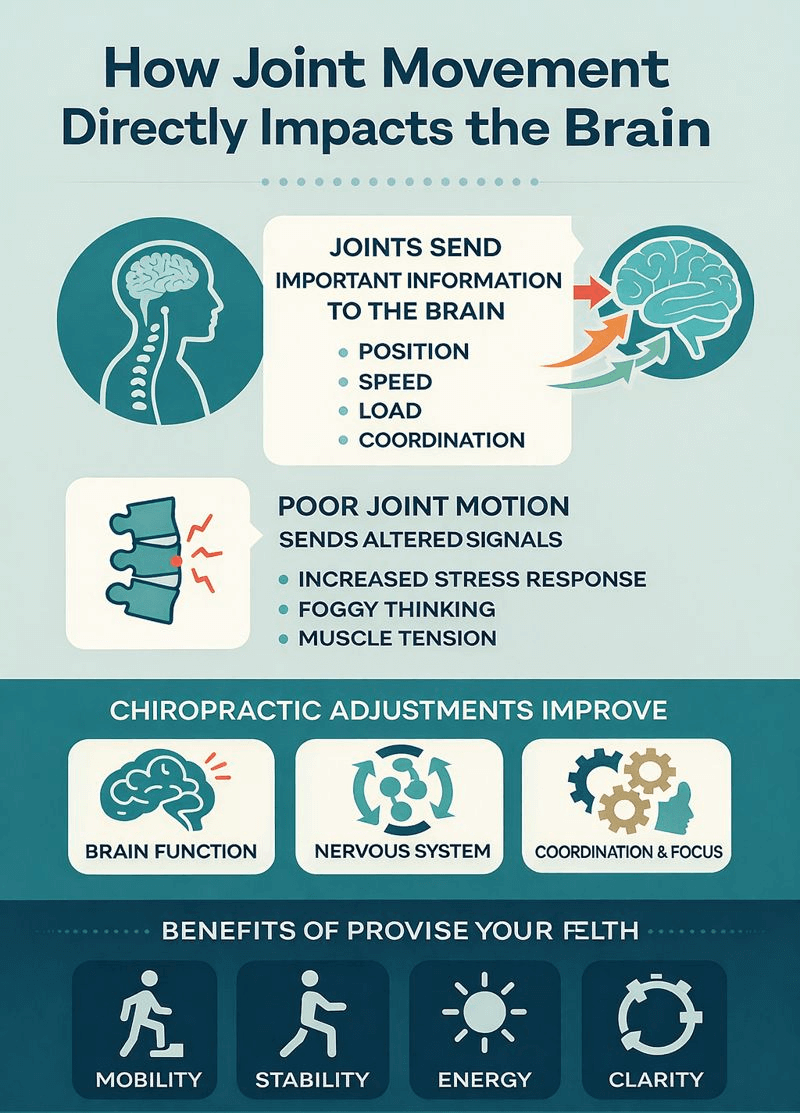
Movement isn’t just about muscles, flexibility, or avoiding stiffness after a long day at your desk. Every single joint in your body acts like a high-speed information hub, constantly sending data to your brain about position, load, speed, and coordination. When joint movement is healthy, the brain receives clear, accurate information and can regulate the body with ease. When movement is restricted, chaotic, or inefficient, the brain has to work harder just to keep things running. Think of it like trying to stream a movie on dodgy Wi-Fi. Same movie, more buffering.
At our Wellington chiropractic clinic, we see this neurological connection every day. Joint movement doesn’t just support the brain. It directly shapes how the brain functions.
The Brain Is Obsessed With Movement
Roughly 70–80% of sensory input entering the brain comes from the body, and a significant portion of that comes from joint and muscle receptors known as proprioceptors. These receptors constantly report where your body is in space and how it’s moving. This information feeds directly into areas of the brain responsible for balance, coordination, focus, emotional regulation, and even decision-making.
When joints move well, proprioceptive input is rich and accurate. The brain can predict movement efficiently, regulate muscle tone appropriately, and conserve energy. When joint movement becomes restricted or altered due to injury, stress, repetitive posture, or subluxation, the quality of that input drops. The brain doesn’t get silence, it gets noise. And noisy input forces the nervous system into a more defensive, less efficient state.
What Happens When Joints Don’t Move Properly
Loss of proper joint motion doesn’t just stay local. Research shows that reduced movement in spinal and extremity joints alters sensory input to the brain, particularly in areas like the cerebellum and motor cortex. These regions are critical for coordination, timing, and smooth movement. Over time, this altered input can lead to changes in how the brain maps the body, a phenomenon known as maladaptive neuroplasticity.
This is why people can feel clumsy, stiff, foggy, or “out of sync” even when pain isn’t severe. The brain is compensating. It’s working harder to interpret unclear information, often increasing muscle tension and stress responses in the process. Not ideal when you’re trying to think clearly, move freely, or enjoy your workouts.
Subluxation and the Brain–Body Conversation
From a neuro chiropractic perspective, a subluxation isn’t just about joint dysfunction. It’s about altered communication between the body and the brain. When a joint loses its normal movement patterns, the receptors around that joint stop firing optimally. This reduces high-quality sensory input to the brain and shifts the nervous system toward a protective state.
Studies using EEG and functional MRI have shown that spinal adjustments can influence brain activity, particularly in areas associated with sensory processing, motor control, and prefrontal cortex function. That’s the part of the brain responsible for focus, emotional regulation, and executive function. In simple terms, restoring joint movement can help the brain calm down, sharpen up, and function more efficiently.
Movement Is Brain Fuel, Not Just Exercise
It’s no coincidence that movement-based practices are strongly linked to cognitive health. Regular, varied joint movement has been shown to improve reaction time, memory, mood, and stress resilience. One study found that increased proprioceptive input improves cortical integration, meaning the brain processes information faster and more accurately.
This is why movement quality matters just as much as movement quantity. You can smash out workouts all week, but if certain joints aren’t moving properly, the brain is still operating with incomplete information. Chiropractic care focuses on restoring precise joint motion so the nervous system gets the clean input it needs to adapt and thrive.
Why Chiropractic Care in Wellington Focuses on the Brain
As a chiropractor in Wellington, our approach isn’t about chasing symptoms. It’s about improving how your nervous system perceives and responds to the world. Specific chiropractic adjustments aim to restore proper joint motion, particularly in the spine, where sensory input has a powerful influence on brain function.
When joint movement improves, many people notice they move more freely, recover faster, feel more focused, and experience greater ease in daily life. That’s not magic. That’s neurology doing what it does best when given the right input.
Your brain doesn’t separate movement from function. Neither do we.
If you’re feeling stiff, flat, foggy, or stuck in the same patterns despite doing “all the right things,” it may be time to look at how well your joints are communicating with your brain. Because better movement doesn’t just change how your body feels. It changes how your brain works.
Scientific References
Haavik, H., & Murphy, B. (2012). The role of spinal manipulation in addressing disordered sensorimotor integration and altered motor control. Journal of Electromyography and Kinesiology, 22(5), 768–776.
Pickar, J. G. (2002). Neurophysiological effects of spinal manipulation. The Spine Journal, 2(5), 357–371.
Nijs, J., et al. (2012). Maladaptive neuroplasticity in musculoskeletal pain. Manual Therapy, 17(5), 389–395.
Seaman, D. R. (2013). Joint dysfunction, neuroplasticity, and pain. Journal of Chiropractic Medicine, 12(3), 166–173.
Experience Limitless Movement Chiropractic Care in Wellington
If you’re in Wellington and looking for expert chiropractic care, we’re here to help. At Limitless Chiropractic, we focus on helping you move better, feel stronger, and live without limits. Book your appointment today and take the first step toward a healthier, more mobile you!
Ready to begin or continue your healing journey? Let’s work together to unlock your body’s natural potential for wellness.
Book Your Limitless Journey Today
or call us at (04) 891 0911